If you’re starting a business or launching a product, one number you absolutely need to know is your break-even point. It tells you exactly how much you need to sell before you stop losing money and start making any prfit. No guesswork, no gut feeling — just math.
This article breaks down what the break-even point is, why it matters, how to calculate it, and how real businesses use it to make smarter decisions.
What Is the Break-Even Point?
The break-even point (BEP) is the level of sales at which your total revenue equals your total costs — meaning you’re making zero profit, but also zero loss. Every sale after that point starts generating actual profit.
Think of it like this: you open a lemonade stand. You spend $1000 on fixed costs — your stand, the table, and a sign (costs that don’t change no matter how many cups you sell). Each cup costs you a little extra in lemons and sugar — those are your variable expenses, which grow as you sell more.
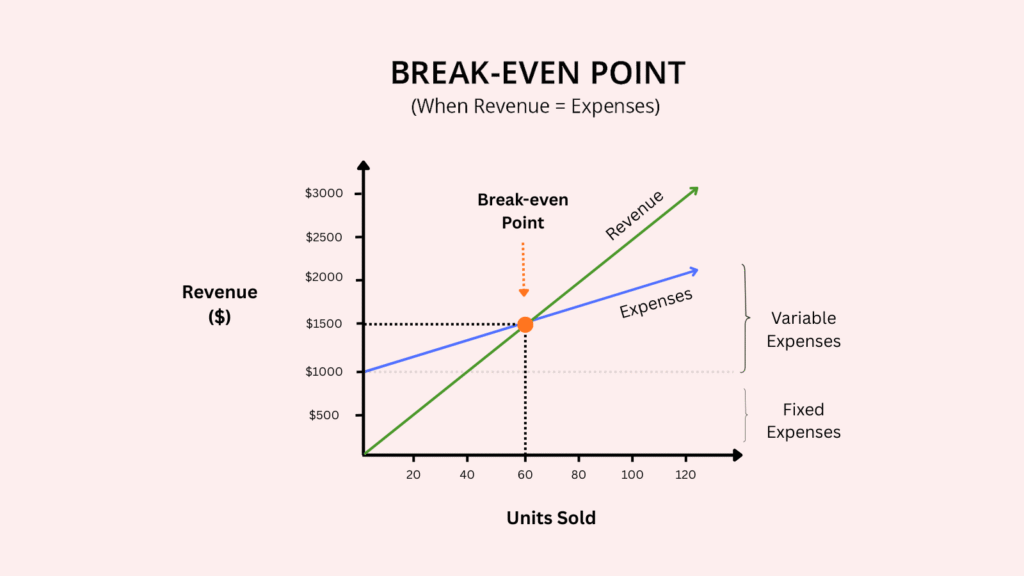
Now look at the chart. The blue line represents your total expenses climbing steadily as you sell more units. The green line is your revenue, starting from zero and rising faster. For the first 60 cups, your expenses are higher than what you’re making — you’re in the red.
But at exactly 60 units sold and $1,500 in revenue, the two lines cross. That’s your break-even point — the orange dot. You’re not losing money anymore, but you’re not profiting yet either.
Sell cup number 61? Now you’re in the green. Every sale beyond that crossing point is where real profit begins.
In business terms, it’s the same idea — just with more moving parts.
Why Does the Break-Even Point Matter?
Understanding your break-even point isn’t just an accounting exercise. It’s a strategic tool that helps you:
- Set realistic sales targets
- Price your products confidently
- Decide whether a business idea is financially viable
- Know when to scale up or cut costs
- Pitch your business to investors with credibility
According to the U.S. Bureau of Labor Statistics, about 20% of new businesses fail within the first year, and nearly 50% fail within five years. One of the leading reasons? Poor financial planning — and not knowing your break-even point is a big part of that.
The Key Components You Need to Know First
Before you calculate anything, you need to understand three core terms:
| Term | Definition | Example |
| Fixed Costs | Costs that don’t change regardless of how much you sell | Rent, salaries, software subscriptions |
| Variable Costs | Costs that increase as you produce or sell more | Raw materials, packaging, shipping per unit |
| Selling Price per Unit | The price you charge customers for one unit | $25 per product |
There’s also a fourth concept worth knowing — Contribution Margin. This is what’s left from your selling price after you subtract variable costs. It’s what actually goes toward covering your fixed costs.
Contribution Margin = Selling Price per Unit – Variable Cost per Unit
The Break-Even Point Formula
There are two common ways to calculate your break-even point — in units and in sales revenue.
1. Break-Even Point in Units
Break-Even Point (Units) = Fixed Costs / (Selling Price per Unit − Variable Cost per Unit)
This tells you how many units you need to sell to cover all your costs.
2. Break-Even Point in Sales Revenue
Break-Even Point (Revenue) = Fixed Costs / Contribution Margin Ratio
Where:
Contribution Margin Ratio = Contribution Margin per Unit / Selling Price per Unit
This version is more useful when you’re selling multiple products or services.
A Real-World Example (Let’s Do the Math)
Let’s say you’re launching a custom phone case business. Here are your numbers:
- Fixed Costs: $3,000/month (rent, tools, software)
- Selling Price per Unit: $30
- Variable Cost per Unit: $12 (materials + packaging)
Step 1 — Contribution Margin: $30 – $12 = $18 per unit
Step 2 — Break-Even Point in Units: $3,000 ÷ $18 = 167 units
That means you need to sell 167 phone cases every month just to break even. Case 168? That’s where profit begins.
Step 3 — Break-Even in Revenue: Contribution Margin Ratio = $18 ÷ $30 = 0.60 (or 60%) Break-Even Revenue = $3,000 ÷ 0.60 = $5,000/month
So you need to generate at least $5,000 in monthly sales before you’re profitable.
What Happens When Variables Change?
This is where break-even analysis gets genuinely powerful. You can use it to model different scenarios:
- If you lower your price to $25, your contribution margin drops to $13 → break-even jumps to 231 units. That’s 38% more sales needed for the same result.
- If you cut variable costs from $12 to $9, your margin improves to $21 → break-even drops to 143 units.
- If fixed costs increase to $4,000 (new hire, bigger space), you now need to sell 223 units to break even.
Running these scenarios before making decisions is exactly how seasoned entrepreneurs avoid costly mistakes.
Common Mistakes to Avoid
Even a simple break-even calculation can go wrong. Watch out for these pitfalls:
- Forgetting hidden fixed costs — things like annual software renewals, insurance, or loan repayments
- Miscategorizing costs — some costs are semi-variable (like utilities), and misclassifying them skews your numbers
- Ignoring taxes — your break-even in revenue is pre-tax; your actual profit target needs to account for tax obligations
- Treating it as a one-time calculation — your break-even point changes as your costs, prices, and product mix evolve. Revisit it quarterly.
Break-Even Analysis: Limitations to Keep in Mind
Break-even analysis is a great starting point, but it has real limitations:
- It assumes you sell everything you produce — not always realistic
- It works cleanly with one product but gets complex with multiple offerings
- It doesn’t account for market demand — knowing you need to sell 500 units means nothing if the market won’t support it
- It’s based on estimates, so the quality of your inputs directly affects your output
Use it as a planning compass, not a guarantee.
Final Takeaway
The break-even point is one of the most practical financial concepts you’ll use as an entrepreneur or business student. It takes the uncertainty out of early-stage decision-making and replaces it with clear, actionable numbers. Once you know your break-even, you can price smarter, plan better, and pitch with confidence.
Start with your own numbers — even rough estimates. A directionally correct break-even calculation beats no calculation every time.