Every customer you’ll ever have goes through a predictable journey — from the moment they first hear about you to the day they either become a loyal fan or disappear forever. That journey is called the customer lifecycle, and understanding it is one of the most practical business skills you can develop.
If you’re building a business or studying marketing, this framework gives you a clear mental model: where is this customer right now, and what do they need from me at this stage? Get that right, and you stop wasting money chasing the wrong people with the wrong message at the wrong time.
Here’s the 6-step customer lifecycle framework, broken down in plain English.
What Is the Customer Lifecycle?
The customer lifecycle describes the stages a person goes through in their relationship with a business — from stranger to buyer to (ideally) repeat customer and advocate.
It’s not just a marketing concept. It’s a business strategy tool. Companies that actively manage each stage of the lifecycle generate significantly more revenue per customer than those who only focus on acquisition. According to research by Bain & Company, increasing customer retention rates by just 5% can increase profits by 25% to 95%.
The 6 Stages of the Customer Lifecycle
| Stage | Customer Mindset | Your Goal |
| 1. Awareness | “I didn’t know this existed.” | Get discovered |
| 2. Consideration | “Is this the right fit for me?” | Build trust and educate |
| 3. Conversion | “Okay, I’m ready to buy.” | Remove friction and close |
| 4. Retention | “Should I come back?” | Deliver value and stay relevant |
| 5. Loyalty | “This is my go-to brand.” | Deepen the relationship |
| 6. Advocacy | “I want to tell others about this.” | Turn customers into promoters |
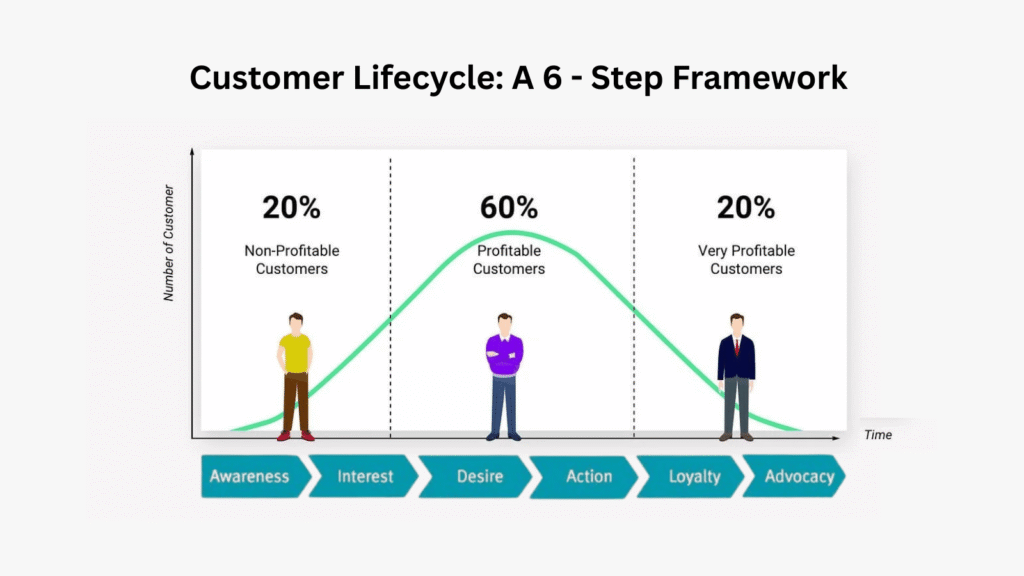
Look at the bell curve in the infographic above. It reveals something most beginner business courses never teach you: not all customers are created equal.
Here’s the breakdown:
- 20% are non-profitable customers — they’re in the early stages (Awareness, Interest). They cost you time and money but haven’t converted yet, or they buy once and disappear.
- 60% are profitable customers — they’ve moved through Desire and Action. They buy, they’re satisfied, but they’re not deeply attached to your brand yet.
- 20% are very profitable customers — these are your Loyalty and Advocacy stage customers. They buy repeatedly, spend more, and bring others in for free.
The insight here is simple but powerful: your top 20% of customers are likely driving the majority of your revenue. This is closely tied to the Pareto Principle — the idea that 80% of your results come from 20% of your inputs. Your job as a business owner isn’t just to get more customers. It’s to move more customers from the left side of that curve to the right.
That’s exactly what this 6-step framework helps you do — intentionally and systematically.
Step 1: Awareness — Getting on Their Radar
This is where everything begins. A potential customer has a problem or a need, and they’re starting to look for answers. They don’t know you yet — you need to show up.
What works here:
- SEO-optimized blog content that answers real questions
- Short-form video (Reels, YouTube Shorts, TikToks)
- Paid ads targeting cold audiences
- Word-of-mouth referrals from existing customers
The #1 mistake beginners make at this stage: trying to sell immediately. Awareness is not the time to pitch. It’s the time to be genuinely useful. Think about what your potential customer is Googling at 11pm — and be the answer.
Step 2: Consideration — Earning Their Trust
Now they know you exist. But they’re comparing you with competitors, reading reviews, and asking themselves: “Is this legit? Is this worth my money?”
This stage is where most businesses lose customers without realizing it. Your content, your website, your social proof — all of it either builds confidence or destroys it.
What works here:
- Case studies and customer testimonials
- Comparison guides (“Us vs. Competitor X”)
- Free resources like checklists, webinars, or email sequences
- A clear, professional website that communicates your value proposition instantly
A practical insight: Nielsen research consistently shows that 88% of consumers trust online reviews as much as personal recommendations. If you don’t have visible social proof at this stage, you’re fighting with one hand tied behind your back.
Step 3: Conversion — Turning Interest Into Action
This is the moment of purchase — but it rarely happens automatically. The customer is ready, but friction can kill the deal. A confusing checkout process, unclear pricing, or a slow website can make a willing buyer walk away.
What works here:
- Simple, transparent pricing
- Clear calls-to-action (CTAs)
- Limited-time offers or guarantees to reduce perceived risk
- Abandoned cart emails for e-commerce
- Fast, mobile-optimized checkout experience
Here’s something most beginner guides skip: conversion isn’t just about getting the sale. It’s about setting expectations correctly. A customer who buys with accurate expectations is far more likely to come back. Overselling at this stage creates returns, complaints, and negative reviews — all of which kill your growth.
Step 4: Retention — Keeping Them Coming Back
Here’s the financial reality of the customer lifecycle: acquiring a new customer costs 5 to 7 times more than retaining an existing one, according to Forbes. Yet most early-stage businesses pour 90% of their budget into acquisition and almost nothing into retention.
Retention is where real profitability lives.
What works here:
- Personalized follow-up emails after purchase
- Loyalty programs or membership perks
- Regular check-ins or value-add content (newsletters, tutorials)
- Excellent customer support that resolves issues fast
- Asking for feedback — and actually acting on it
Retention isn’t just about discounts or loyalty points. It’s about making customers feel seen and valued. That emotional connection is what keeps them from switching to a competitor the moment they see a cheaper option.
Step 5: Loyalty — Making You Their Go-To Brand
Retention gets them to come back. Loyalty is what happens when coming back becomes a habit — when a customer stops comparing you to competitors and simply defaults to you. This is the stage most businesses never intentionally build toward, yet it’s where the biggest lifetime value lives.
A loyal customer doesn’t just buy again. They buy more, complain less, and forgive mistakes more easily. According to Motista research, emotionally connected customers have a 306% higher lifetime value than those who are merely satisfied.
What works here:
- VIP programs or tiered membership rewards
- Exclusive early access to new products or features
- Personalized experiences based on purchase history
- Consistent brand communication that reinforces their identity
- Making customers feel like insiders, not just buyers
The shift from retention to loyalty is mostly emotional. At the retention stage, customers ask “should I come back?” At the loyalty stage, they never even ask the question — you’re already their default choice.
Step 6: Advocacy — Your Most Powerful Marketing Channel
A loyal customer who tells their friends about you is worth more than any ad you could ever run. This is the advocacy stage — where satisfied customers become unpaid brand ambassadors.
According to Nielsen, 92% of people trust recommendations from friends and family over any form of advertising. That’s the power of advocacy, and it’s completely free — if you’ve done the previous five stages well.
What works here:
- Referral programs with real incentives
- Easy sharing mechanisms (review prompts, share buttons)
- Creating “wow” moments that customers naturally want to talk about
- Featuring customers in your content (user-generated content)
- Building a community around your brand
How to Apply This Framework Starting Today
You don’t need a massive budget or a full marketing team to work with the customer lifecycle. Here’s a simple starting audit you can do right now:
- Map your current customers — Which stage are most of them in?
- Identify the weakest link — Where are people dropping off? Awareness? Conversion? Retention?
- Fix one stage at a time — Don’t try to overhaul everything at once. Focus on the stage causing the most leakage.
- Measure what matters — Track metrics by stage: reach (awareness), click-through rate (consideration), conversion rate, churn rate (retention), repeat purchase rate (loyalty), and referral rate (advocacy).
Final Thought
The customer lifecycle isn’t a one-time funnel you build and forget. It’s a living system that evolves as your business grows. The businesses that win — whether they’re solo founders or fast-growing startups — are the ones that treat every stage of the customer journey with intention.
Start small. Pick the stage where you’re losing the most customers right now, and put your energy there first. That single move can be the difference between a business that struggles to grow and one that compounds.